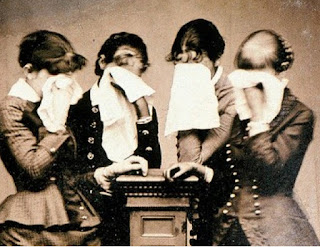
 |
| Grieving Victorians |
October seems a fitting month to share a post on mourning customs in the 19th century.
A LITTLE HISTORY
Victorians had a morbid fascination--some might call it an obsession--with death and dying. Many books were written on the subject of how to mourn, what to wear, when to wear it, and many other customs--some of which we might find downright bizarre.
The queen started it, so
we can blame her. When Prince Albert died in 1861, Queen Victoria went into
mourning, and she continued to wear black for the rest of her life. Her prolonged and highly visible grieving influenced
society on both sides of the ocean.
 |
| Queen Victoria in mourning |
That same year, the American Civil War
began. Death on a massive scale affected families and communities. Mourning
became a central fact of wartime. After the war, death continued to be
ritualized.
MOURNING RITUALS
 |
| Hair Jewelry |
During the Victorian era,
customs dictated every aspect of life—and death. Social decorum dictated how family
members dressed and behaved after the death of a close relative. Black was the
“in” color, all the way down to underclothes and handkerchiefs. The mourning
dress would be solid black, symbolic of spiritual darkness, made of
non-reflective material like bombazine, and trimmed in crape (crepe), a
scratchy silk with a crimped appearance produced by heat. Merchants weren’t
about to miss out on the opportunity and mourning apparel became the first “off
the rack” clothing. If one couldn’t afford a new outfit, they dyed existing
clothes black.
 |
| Mourning Accessories |
Personal stationery and
handkerchiefs carried a black border, with a wide border indicating a very
recent death. Widows were expected to wear black two years, after that they could
go into half-mourning, in gray, mauve, and white.
Mourning jewelry was
popular, especially pieces made with the loved one’s hair. (Don’t even get
me started on Victorian hair art, another peculiar custom.) Women in mourning
carried or wore “tear catchers” made from glass vials or tiny urns. Tears were captured, the vials capped. Supposedly,
when the tears evaporated the mourning period would be over.
Women covered their faces
with veils, which kept red-rimmed eyes hidden. But there was also a
superstition that the spirits of the departed hovered around those they loved.
If a passerby looked directly on the mourner's face, that spirit might attach
itself to the person.
 |
| Widow in full mourning |
In fact, superstitions and
customs went hand-in-glove, you might say.
A wreath of laurel, yew or
boxwood tied with crape or black ribbons hangs on the front door to alert
passersby that a death had occurred. All over the house, black material covers
windows, pictures and mirrors. Many rituals were based on superstitions.
*Stop the clock at the
death hour to avoid bad luck.
*Turn down family
photographs so the wandering soul could not take possession of the living
*When there was a corpse
in the house you had to cover all the mirrors, so the soul would not be trapped
behind the glass.
*Carry the corpse out feet
first because if it’s carried out head first, it could look back and beckon
others to follow it into death.
Mourners greeted guests
coming to pay respects and, served “funeral biscuits” – small cakes wrapped in
white paper and sealed with black sealing wax.
 |
| Death Room Photograph |
In the parlor, called the
“death room” when a coffin was on display, lilies and other fragrant flowers
fill the room (or flowers made from human hair, often the deceased’s), and a
portrait of the deceased taken after
death stands near the coffin.
During this era,
post-mortem portraits became very popular.
The body would be watched over every minute until burial, hence the custom of “waking”. The wake also served as a safeguard from burying someone who was not dead but in a coma. Wakes also lasted several days to allow relatives to arrive from far away. The use of flowers and candles helped to mask unpleasant odors in the room. Burial usually followed four days after death. Lavish meals would be served to guests after the internment.
 |
| Post Mortem (see stand behind her?) |
Photography was still fairly new and
expensive. In many cases, this would be the only picture families had of their
loved ones.
The photo shoots became quite elaborate. Corpses would be propped
up with devices, sometimes eyes would be painted over closed lids, and if decomposition
occurred before the photo could be made, death masks would be employed.
A widespread concern in
the nineteenth century was the fear of being buried alive. Coffin alarms were
developed. A bell was attached to the headstone with a chain that led down into
the coffin to a ring that went around the finger of the deceased.
Some expressions that came from this era: “Saved by the bell." Also, "dead ringer.”
 |
| Coffin Alarm |
Another concern was grave
robbery. The culprit? Usually men hired
by doctors (or the doctors themselves) who needed fresh cadavers for dissection
classes. They earned the name "Resurrection Men."
“Bricking-over” a grave was a way of guaranteeing some
security after death.
Death Comes Calling
At the beginning of my latest novel, Fugitive Hearts, the heroine's husband is killed. She claims the shooting was accidental, but as gossip spreads, people begin to suspect her of murder.
 |
| Available from Amazon and major retailers |
“Sheriff…I just shot my
husband.”
Hotel
owner Claire Daines is a respected member of the community. Until she shocks
the entire town by rushing into a saloon wearing only her nightclothes and
confessing to very inebriated lawman.
Is
she a killer? Is she crazy? Or is she covering up something worse?
For
years, Claire hushed up her husband’s dangerous condition to guard his
reputation. When tragedy strikes, she puts her own life at risk when she vows
to keep another terrible secret.
Sheriff
Frank Garrity must get to the truth, although the tough, hard-drinking lawman
hides his own secrets and would rather walk a lonely path than face his demons.
But as Frank unravels Claire’s subterfuge and unlocks her heart, he’s torn between
his desire to save her and his duty to bring her to justice.
Here's an excerpt:
Observing proper protocol, Claire has stayed with her husband's body all night and remains beside the coffin the next day as guests--including the town's worst gossips--come by to pay their "respects."
“Make way, make way…” The mournful wail came as a surprise, but not
nearly as surprising as who appeared in a parted sea of mourners. Gertrude Bond
paraded across the room in a black silk gown trimmed sumptuously in velvet,
with a matching bonnet, clutching a lace fan—never one to miss an opportunity
to make a fashion statement.
On a gold chain around her neck hung a delicate glass vial. Why the
lachrymatory? She wasn’t family, wasn’t even a close friend. She had as much
need of a tear-catcher as a crocodile.
She paused in front of the coffin, flanked by her followers, which
included the mayor’s wife. That was the bitterest pill for Claire to swallow,
seeing former friends switch loyalties after her brother left town
and another man took his place.
The new general manager’s flamboyant wife drew the fan to her shapeless
breast with a loud sigh. “What a terrible, terrible loss. An honorable,
respected man like Mr. Daines cut down in his prime.”
The room went silent. There were some sharp looks, but no one rebuked
the harpy for her rudeness. Instead, they turned away and pretended not to
notice, no doubt because of her influential position in the community.
In a brief fantasy, Claire stuffed her black handkerchief into the
other woman’s mouth. But no, things were bad enough without creating a
spectacle. She gave a cool, but polite, reply. “Thank you for coming by to pay
your respects.”
Gertrude maintained a mournful expression, practiced enough to appear
convincing. “Do allow me to convey our deepest condolences for your loss. I’m
sure your heart must be broken. With your husband gone, what will you do?”
This wasn’t the time or place to be discussing her future, and she
certainly wasn’t filling Mrs. Bond in on her plans. “I’m afraid I can’t think
past the moment.”
“Of course. You’re beset with grief, a very great burden to bear alone.
Family can be a comfort. Have you sent for your brother?”
Oh, Gertrude would love that. She took every opportunity to remind
people that the former general manager had left under the shadow of scandal,
and even went so far as to suggest Henry was guilty of defrauding the railroad
instead of his assistant, Caldwell, the man who’d murdered the investigator and
very nearly killed Henry.
Claire had written to advise her brother and sisters of Frederick’s
death, but not the manner in which he had died. With the trouble she’d caused
her siblings over the years, she didn’t want to add humiliation to the list. “My
family has been informed,” she said simply.
“Then you’ll be going to live with them?”
Why did the wretched woman care?
“There’s no reason for me to burden them. My home is here.”
Gertrude looked strangely annoyed. “You wish to remain in Parsons?”
“Why wouldn’t I?”
“To avoid jail, I suppose.”
What odd customs surrounding death and mourning have you heard about? Comment and enter the drawing for your chance to win a copy of the first book in the series, Steam! Romance and Rails.
a Rafflecopter giveaway


 KATE'S OUTLAW - Book 2, novella Railroad heiress Kate Parsons takes matters into her own hands to resolve a land dispute with the Indians. After she’s abducted by mistake and then rescued by her captor, she discovers that the Cherokee outlaw isn’t the real savage. Now she’s in a race to put an end to the hostilities and clear his name before it’s too late.
  A DANGEROUS PASSION - Book 3, full-length novel
  For years, Claire hushed up her husband’s dangerous condition to guard his reputation. When tragedy strikes, she puts her own life at risk when she vows to keep another terrible secret. Sheriff Frank Garrity must get to the truth, although the hard-drinking lawman hides his own secrets. But as Frank unravels Claire’s subterfuge and unlocks her heart, he’s torn between his desire to save her and his duty to bring her to justice.