

Who’s next on my North of the Border guest blog series? Today we have Marisa Masterson, author of Manny’s Triumph.
Where does Marisa get her inspiration? How is Canada part of her inspiration? Read on and see...
~ * ~
Canada—An Immigrant Hub
As a writer, I dig through family history for ideas and character names. I was raised by grandparents and heard fantastic stories about my ancestors. That said, I had no idea my family and countless others actually immigrated by way of Canada. This set me on my researching journey. After all, this would make for a great part in a novel. I could see it in my mind--immigrant heroine lands in Canada and travels across that country by covered wagon in order to reach the Cornish community in Southwestern Wisconsin.
Statistics I discovered really surprised me. For over a hundred years, eight people left Canada for every ten that arrived as immigrants. So where did they go? Though a very few returned to their native country, most headed to the United States.
Before I started searching for an answer to my question of where the emigrants from Canada went, I already knew that logging drew many Canadians away from their country. As I wrote my book Manny’s Triumph, I looked into the history of the lumber camps and learned that Canadians made up the majority of workers there. In fact, the term lumberjack is a Canadian word. Northern Michigan and Wisconsin experienced a lumber boom that started around the 1830s, and my home of Saginaw was a sort of “command central” in the Michigan lumber trade. (Logging image courtesy of https://fineartamerica.com/featured/michigan-lumbering-granger.html.)

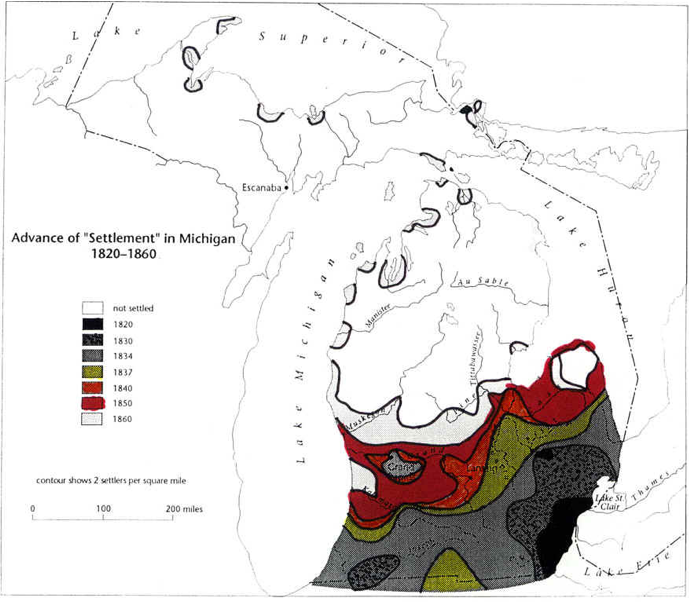
Something called Michigan Fever called to many people, natural Canadians and immigrants alike. According to familysearch.org, “During the "Michigan Fever" of the 1830s, large numbers of Canadians streamed westward across the border.” Though I grew up in Wisconsin, Michigan is now my home state. I had no idea that many people from Canada bought land in it. In fact, during this time period, more than three times the amount of land was settled. That equaled a huge population explosion, mostly in the Detroit area which is one of our key areas in Michigan.
Image courtesy of http://geo.msu.edu/extra/geogmich/michigan_fever.html

Families like my own came decades later. In Wisconsin, if people entered the country through Milwaukee, then very likely that they’d “arrived first at a port in Canada, and then came through the St. Lawrence River and Great Lakes to enter the United States at Wisconsin.” (https://www.familysearch.org/wiki/en/Wisconsin_Emigration_and_Immigration) Most of the English and Scottish settlers to Wisconsin came through Canada and then dispersed. My own family stayed in the Cornish pocket found in Southwestern Wisconsin, a group that made up nearly one third of the British coming to Wisconsin. Many of the settlers, both farmers and miners, traveled across Canada to reach an area of the country which reminded them of Cornwall. My great-great grandparents met there and later married, both having been for a brief time residents of Canada.

 Marisa Masterson and her husband of thirty years reside in Saginaw, Michigan. They have two grown children, one son-in-law, a grandchild on the way, and one old and lazy dog.
She is a retired high school English teacher and oversaw a high school writing center in partnership with the local university. In addition, she is a National Writing Project fellow.
Focusing on her home state of Wisconsin, she writes sweet historical romance. Growing up, she loved hearing stories about her family pioneering in that state. Those stories, in part, are what inspired her to begin writing.
As a writer, I dig through family history for ideas and character names. I was raised by grandparents and heard fantastic stories about my ancestors. That said, I had no idea my family and countless others actually immigrated by way of Canada. This set me on my researching journey. After all, this would make for a great part in a novel. I could see it in my mind--immigrant heroine lands in Canada and travels across that country by covered wagon in order to reach the Cornish community in Southwestern Wisconsin.
Statistics I discovered really surprised me. For over a hundred years, eight people left Canada for every ten that arrived as immigrants. So where did they go? Though a very few returned to their native country, most headed to the United States.
Before I started searching for an answer to my question of where the emigrants from Canada went, I already knew that logging drew many Canadians away from their country. As I wrote my book Manny’s Triumph, I looked into the history of the lumber camps and learned that Canadians made up the majority of workers there. In fact, the term lumberjack is a Canadian word. Northern Michigan and Wisconsin experienced a lumber boom that started around the 1830s, and my home of Saginaw was a sort of “command central” in the Michigan lumber trade. (Logging image courtesy of https://fineartamerica.com/featured/michigan-lumbering-granger.html.)

Something called Michigan Fever called to many people, natural Canadians and immigrants alike. According to familysearch.org, “During the "Michigan Fever" of the 1830s, large numbers of Canadians streamed westward across the border.” Though I grew up in Wisconsin, Michigan is now my home state. I had no idea that many people from Canada bought land in it. In fact, during this time period, more than three times the amount of land was settled. That equaled a huge population explosion, mostly in the Detroit area which is one of our key areas in Michigan.
Image courtesy of http://geo.msu.edu/extra/geogmich/michigan_fever.html
Families like my own came decades later. In Wisconsin, if people entered the country through Milwaukee, then very likely that they’d “arrived first at a port in Canada, and then came through the St. Lawrence River and Great Lakes to enter the United States at Wisconsin.” (https://www.familysearch.org/wiki/en/Wisconsin_Emigration_and_Immigration) Most of the English and Scottish settlers to Wisconsin came through Canada and then dispersed. My own family stayed in the Cornish pocket found in Southwestern Wisconsin, a group that made up nearly one third of the British coming to Wisconsin. Many of the settlers, both farmers and miners, traveled across Canada to reach an area of the country which reminded them of Cornwall. My great-great grandparents met there and later married, both having been for a brief time residents of Canada.
~ * ~

From a logging camp to a local farm, this man and woman are on a collision course that leads them into marriage and a fight for Carlene’s life. Will Carlene’s determination and Manny’s desire to save her be enough to give them a happy ending?
~ * ~
 Marisa Masterson and her husband of thirty years reside in Saginaw, Michigan. They have two grown children, one son-in-law, a grandchild on the way, and one old and lazy dog.
She is a retired high school English teacher and oversaw a high school writing center in partnership with the local university. In addition, she is a National Writing Project fellow.
Focusing on her home state of Wisconsin, she writes sweet historical romance. Growing up, she loved hearing stories about her family pioneering in that state. Those stories, in part, are what inspired her to begin writing.
Let’s keep in touch…
Don’t forget to visit my website—www.marisamasterson.com
~ All pictures (except for the 1st) are supplied by today’s guest with their assurance of usage rights.


