Showing posts with label #marktwain. Show all posts

2/08/2022

Romancing Mark Twain with E.E. Burke

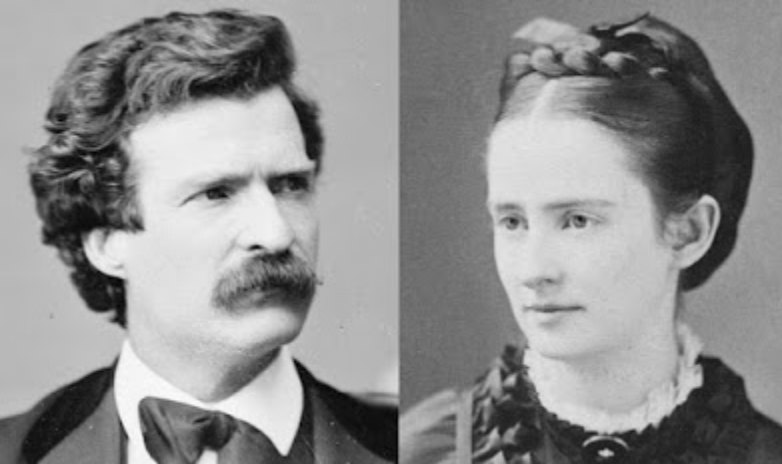
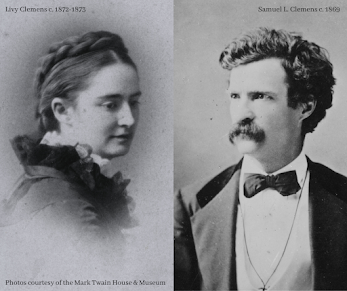
Livy and Sam 

The author Mark Twain is best remembered for his satire and his scathing observations about human nature. But there was another side to the man, Samuel Clemens--a romantic one. 

At age 32, Sam returned from a successful trip abroad with a new friend, Charles Langdon, who invited Sam to an outing with his family. It was late December 1867 when Sam joined the Langdons at Steinway Hall in New York City to hear Charles Dickens read from David Copperfield. The reading didn’t impress Sam, but the young woman he met certainly did. He says of his official “first meeting” with Olivia Langdon: “It made the fortune of my life--not in dollar, I am not thinking in dollars; it made the real fortune of my life in that it made the happiness of my life.”

At first, happiness wasn’t certain. With typical spontaneity, Sam popped the question soon after the first date. Livy turned him down. Crushed, though not defeated, he penned a respectful, yet ardent, letter, the first of many in their two-year courtship. Here’s an excerpt from that letter, in which he claims to accept her refusal and addresses her as “honored sister.” 

For once, at least, in the idle years that have drifted over me, I have seen the world all beautiful, & known what it was to hope. For once I have known what it was to feel my sluggish pulses stir with a living ambition. The world that was so beautiful, is dark again; the hope that shone as the sun, is gone; the brave ambition is dead. Yet I say again, it is better for me that I have loved & do love you; that with more than Eastern devotion I worship you; that I lay down all of my life that is worth the living, upon this hopeless altar where no fires of love shall descend to consume it. If you could but—

He goes on to profess friendship, but he more or less begs her to open her heart and give him a chance. She does, and after two years and many more letters, finally admits to loving him, but adds that she hopes it will pass!

Sam, undaunted, redoubles his efforts until his determination pays off. Triumphant, he writes to share the news in a letter to his friend, Joseph Twichell. Here's a brief excerpt:

Refused three times—warned to quit, once—accepted at last!—& beloved!—Great Caesar's Ghost, if there were a church in town with a steeple high enough to make an object of it, I would go out and & jump over it. And I persecuted her parents for 48 hours & at last they couldn’t stand the siege any longer & so they made a conditional surrender:—which is to say, if she makes up her mind thoroughly & eternally, & I prove that I have done nothing criminal or particularly shameful in the past, & establish a good character in the future & settle down, I may take the sun out of their domestic firmament, the angel out of their fireside heaven...
Oh, no—there isn’t any persistence about me—certainly not. But I am so happy I want to scalp somebody.

Mark Twain House, Hartford CT
Sam and Livy spent their happiest years in their romantic home in Hartford, CT.  Four years into marriage, Sam pens an endearing letter to his wife from London that ends with him imagining his return. I love to write about arriving—it seems as if it were to be tomorrow. And I love to picture myself ringing the bell, at midnight—then a pause of a second or two—then the turning of the bolt, & “Who is it?”—then ever so many kisses—then you & I in the bath-room, I drinking my cock-tail & undressing, & you standing by—then to bed, and — —everything happy & jolly as it should be. 
I do love & honor you, my darling.
Saml.

Photos and letters courtesy of the Mark Twain House and Museum. Home photos by John Groo.

💖💖💖💖💖
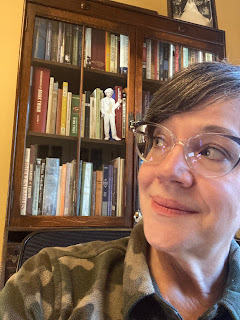
A "shelfie" with Mark and me 
Be my guest at Romancing Mark Twain

Join me for an exclusive online Valentine's event Feb. 15, at 7 p.m. Eastern.  I'll be appearing with Rebecca Floyd, the Director of Interpretation at the Mark Twain House & Museum in Hartford, Conn., to talk about how Mark Twain inspired me to write love stories featuring his beloved characters. You'll also hear more about the true love story between Sam and Livy.

Through the technological wonder of Crowdcast, you can join us for this LIVE online discussion from the comfort of your home. Watch the program online, and, if you’d like, participate in the Q&A.

FREE digital tickets are waiting for you to claim them. All you have to do is sign up at the Mark Twain House & Museum's online event page. Select 1 "digital connection" to order your front row seat. Don't worry, you will not be charged. If you wish to make a donation to this worthy institution, you can do so, though it is not required. 

I hope you'll be there on the evening of Feb. 15 at 7 p.m. EST. (6 p.m. Central Time). 


Have you read one or both of my New Adventures books? If so, I'd love to hear what you thought about these "grown up" characters. If not, tell me which character--Tom or Huck--you think would be your favorite. 

Happy Valentine's Day! 


6/18/2019

E.E. Burke On The Journey: an inspiring love story

Love seems the swiftest, but it is the slowest of all growths. No man or woman really knows what perfect love is until they have been married a quarter of a century. ~ Mark Twain, Notebook, 1894

Sam and Livy: A Love Story

By E.E. Burke
(Pictured above: Sam and his Livy.)
As a romance writer, I’m always on the look-out for great love stories. One of the most poignant is the romance between Sam Clemens (Mark Twain) and Olivia Langdon. What an unlikely pair they were. Olivia, known as Livy, had a proper Eastern upbringing in a family of high social standing. Sam was a westerner with many rough edges. He grew up poor and left school at age 12. In contrast to Livy’s even temperament and piety, Sam had explosive bouts of anger; he smoked, drank and could out-swear a sailor. Nevertheless, these two found in each other a love that only deepened over the years.
Clemens reported that he fell in love with Olivia when he first saw her in an ivory miniature on board a ship with her brother in 1867. He met her the following December, 1868.
He later wrote in The Autobiography of Mark Twain: “She was slender and beautiful and girlish–she was both girl and woman. She remained both girl and woman to the last day of her life.”
Within days of meeting Livy. he proposed marriage. She refused. It took real determination to convince her to marry him–more than 180 letters over 17 months.
He later wrote: “She said she never could or would love me – but she set herself the task of making a Christian of me. I said she would succeed, but that in the meantime, she would unwittingly dig a matrimonial pit and end by tumbling into it.”
She did indeed take the tumble and loved Sam for 34 years until the day of her death in 1904.
This poignant recollection from Twain’s autobiography gives some insight into one of the reasons he loved his Livy so faithfully and passionately. “She poured out her prodigal affection in kisses and caresses, and in a vocabulary of endearments whose profusion was always an astonishment to me.”
Sadly, the devoted couple experienced heartbreaking loss. Their first child, Langdon, died of diphtheria before he reached his second year. They lost daughter Susy, 24, to meningitis, and Jean died from epilepsy at 29. Clara was estranged from her father for many years although they reconciled before his death. Clara lived to age 88, but left no children.
Sam and Livy’s love story is, in part, what inspired me to write love stories for the beloved characters Mark Twain created. I like to think Sam would appreciate the difficulties both Tom and Huck face when they fall in love.
~~~
I noticed some pieces of limbs and such things floating down, and a sprinkling of bark; so I knowed the river had begun to rise. ~ Mark Twain, Adventures of Huckleberry Finn

Life On The Big Muddy

This year, those of us in the Midwest have been reminded of the Missouri River’s power and unpredictability. But the Big Muddy has always been a dangerous river.
Ever Changing Channels: The Missouri River has never liked to stay in predictable channels. According the Mark Twain’s writings, 19th century pilots on the Mississippi River could memorize that river enough to run at night. But steamboats on the Missouri River would only travel during the day when the pilots could actually observe the river because it changed so often. The course they took on the trip upriver could be entirely different from the one they encountered coming back downriver.
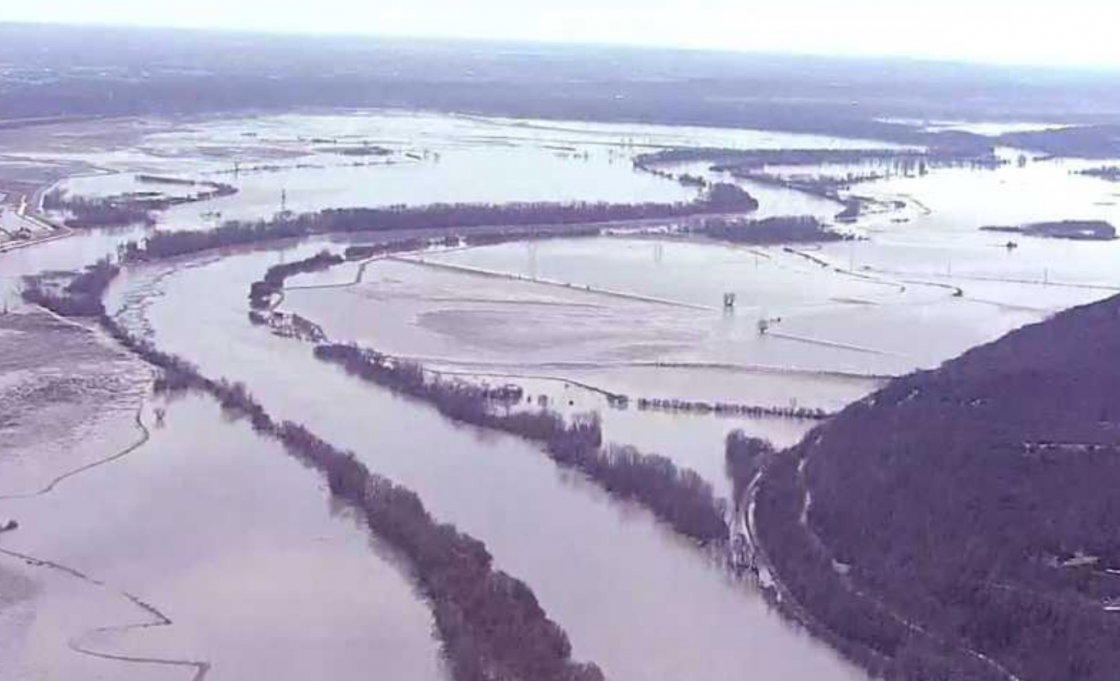
Spilling over its banks: This aerial photo from KMBC-News in Kansas City shows historic flooding in Platte County, MO (about a half hour north of where I live). While doing research for Taming Huck Finn, I read about a famed Mississippi River steamboat pilot who made one journey up the Missouri River in the early 1870s, and declared he would never do it again. He said only a madman would attempt to pilot such a wild, unpredictable river. It sounded to me like the kind the river that would appeal to Huck Finn.
If you’d like to check out my novel Taming Huck Finn, download a free first chapter. Or use this universal link to purchase: books2read.com/huckfinn
This article originally appeared in the first edition of newsletter On The Journey. Would you like to have it personally delivered to your email? This brief informational e-newsletter is sent out only once a month to my subscribers. Here’s where to sign up: www.eeburke.com/newsletter.
*Train photography in newsletter banner by Matthew Malkiewicz. See more of his lovely photography at www.losttracksoftime.com.
Is there a real life love story that has inspired you? If so, tell me about it. 

I'll draw a random winner from comments for a copy of Taming Huck Finn. (Leave your email address if you want to be entered).


10/02/2018

E.E. Burke's Best of the West: An old friend, a new adventure...

Join the adventure on Oct. 23


His greatest adventure is about to catch up with him.

Steamboat pilot Huck Finn lives life on his terms and steers clear of messy entanglements that might tie him down—until he takes charge of an orphaned boy that needs rescuing.

Starched and proper, Miss Hallie MacBride is determined to atone for past sins by raising her estranged sister’s son. She doesn’t expect footloose Mr. Finn to challenge her, much less up and run off with her nephew. 

On a wild journey fraught with danger, a freedom-loving adventurer and an avowed spinster battle over the destiny of a young boy, who is doing his level best to convince them they belong together.

Embark on an unforgettable adventure from award-winning author E.E. Burke in a novel inspired by one of America’s most beloved characters.


June 2, 1870, Atchison, Kansas
“What you layin’ in there for, mister?”
A childish voice disturbed Huck’s sleep. He screwed his eyes tightly shut, willing his mind to return to dreams of pleasanter things than inquisitive children. 
Something struck the bottom of his boot. 
He jerked awake, his head connecting with a crack against the inside of the hogshead barrel. “Ow! Blame it.” 
Gingerly, he touched a rising lump and grimaced at the painful reminder of where he’d ended up. After celebrating into the wee hours, it appeared a convenient place to await the next packet chugging up the Missouri River. Sobriety declared it a bad idea. Only halfwits and drunks slept in discarded barrels. Not men who commanded steamboats.
Curling around, he squinted at the opening where his legs were exposed. 
Daylight outlined the figure of a child. 
Huck shut his eyes hoping it was just a dream. When he opened them again, the boy had bent to peer inside the barrel. 
Gap-toothed smile, snub nose, merry eyes that held the promise of mischief…
“Tom?” Huck rasped. 
The boy giggled. 
No, he couldn’t possibly be. Tom had been nearly full-grown fifteen years ago. 
Huck rubbed his stinging eyes. He must’ve gotten ahold of some bad brew like the Fire Rod his old man used to swig by the jug full. That stuff made Pap see crazier things than a boy that wasn’t there.
The spitting image of Tom laughed again. “Uncle Huck?” 
Uncle?
Huck shook his head to clear it. By God, he’d swear off whiskey forever if it brought on these strange imaginings, and it had to be his imagination. Huck Finn weren’t nobody’s uncle.

~~~


E.E. Burke is a bestselling author of emotionally powerful historical and contemporary romances that combine her unique blend of wit and warmth. Her books have been nominated for numerous national and regional awards, including Booksellers' Best, National Readers' Choice and Kindle Best Book. She was also a finalist in the RWA's prestigious Golden Heart® contest. Over the years, she’s been a disc jockey, a journalist and an advertising executive, before finally getting around to living the dream--writing stories readers can get lost in.
Follow E.E. Burke: 
www.facebook.com/AuthorEEBurke
www.twitter.com/author_eeburke
www.goodreads.com/EEBurke
https://www.bookbub.com/authors/e-e-burke
Where did you get the idea for this story?

Mark Twain’s adventures about the boy, Huckleberry Finn, made me wonder what kind of man Huck would’ve grown up to be. I know others have written books that feature this character and interpreted his adulthood in other ways, but this is the story that Huck gave me when I asked him what happened to him after he “set out for the Territory.”

How did you decide what occupation Huck would have as an adult?

It didn’t seem a far stretch to imagine Huck growing up to be a steamboat pilot. He was most at home on the river and had the temperament and intelligence to learn this challenging job. Of course, I couldn’t write a book about Huck being a steamboat pilot without referring to Twain’s Life On The Mississippi, which is largely based on his own apprenticeship as a riverboat pilot. But the books that really fed my imagination were the diaries of Missouri River pilots.

Why put the story on the Missouri River rather than the Mississippi – the original setting?

In Taming Huck Finn, as in Twain’s original book, the river itself is a character. In this case, it’s Missouri River rather than the Mississippi. In the 1870s, the Upper Missouri River formed a natural boundary between civilization and the frontier. What better place for a riverboat pilot who wants to stay one step ahead of civilization? 

The Missouri River of today is nothing like what it was at the time of Huck’s story. Before being dredged and tamed by the Army Corps of Engineers in the early twentieth century, the Big Muddy was a wide, wild, unpredictable river. I have a map that shows where steamboats sank along the old path of the river, and it is littered with wrecks. It was a dangerous job to take a steamboat on the Missouri River, and especially the upper river where it was shallower and rocky and prone to flooding. Just the kind of challenge Huck Finn would relish.

When we meet 30-year-old Huck, the era of the steamboat is slowly giving way to the railroad as a young country pushes westward. Huck sees himself and the old boats as relics of a past that is quickly fading. He’s struggling to figure out how he fits into this new world that is catching up with him. Does he keep running? Or does he risk his freedom to have the one thing that’s eluded him all these years?

You’ll have to read the book to find out.

I'm holding a raffle for two ARC copies of Taming Huck Finn - one print and one ebook. Enter the raffle below and don't forget to comment.

Are you a fan of Mark Twain's original adventures? 
How would you imagine his characters grown up?

a Rafflecopter giveaway