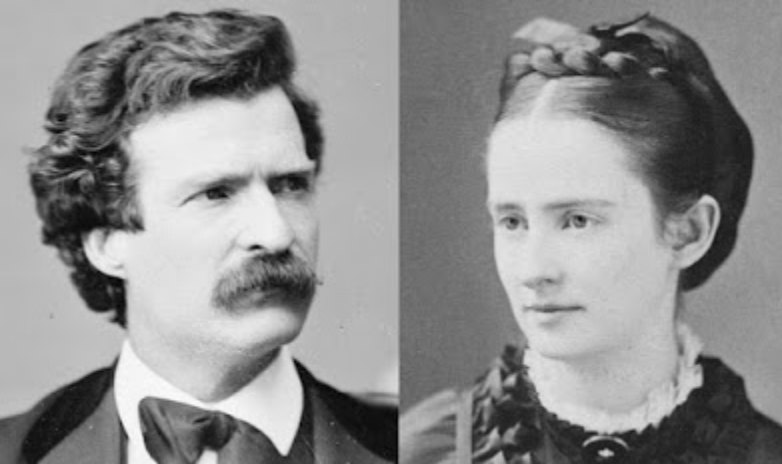
Love seems the swiftest, but it is the slowest of all growths. No man or woman really knows what perfect love is until they have been married a quarter of a century. ~ Mark Twain, Notebook, 1894
Sam and Livy: A Love Story
By E.E. Burke
(Pictured above: Sam and his Livy.)
As a romance writer, I’m always on the look-out for great love stories. One of the most poignant is the romance between Sam Clemens (Mark Twain) and Olivia Langdon. What an unlikely pair they were. Olivia, known as Livy, had a proper Eastern upbringing in a family of high social standing. Sam was a westerner with many rough edges. He grew up poor and left school at age 12. In contrast to Livy’s even temperament and piety, Sam had explosive bouts of anger; he smoked, drank and could out-swear a sailor. Nevertheless, these two found in each other a love that only deepened over the years.
Clemens reported that he fell in love with Olivia when he first saw her in an ivory miniature on board a ship with her brother in 1867. He met her the following December, 1868.
He later wrote in The Autobiography of Mark Twain: “She was slender and beautiful and girlish–she was both girl and woman. She remained both girl and woman to the last day of her life.”
Within days of meeting Livy. he proposed marriage. She refused. It took real determination to convince her to marry him–more than 180 letters over 17 months.
He later wrote: “She said she never could or would love me – but she set herself the task of making a Christian of me. I said she would succeed, but that in the meantime, she would unwittingly dig a matrimonial pit and end by tumbling into it.”
She did indeed take the tumble and loved Sam for 34 years until the day of her death in 1904.
This poignant recollection from Twain’s autobiography gives some insight into one of the reasons he loved his Livy so faithfully and passionately. “She poured out her prodigal affection in kisses and caresses, and in a vocabulary of endearments whose profusion was always an astonishment to me.”
Sadly, the devoted couple experienced heartbreaking loss. Their first child, Langdon, died of diphtheria before he reached his second year. They lost daughter Susy, 24, to meningitis, and Jean died from epilepsy at 29. Clara was estranged from her father for many years although they reconciled before his death. Clara lived to age 88, but left no children.
Sam and Livy’s love story is, in part, what inspired me to write love stories for the beloved characters Mark Twain created. I like to think Sam would appreciate the difficulties both Tom and Huck face when they fall in love.
~~~
I noticed some pieces of limbs and such things floating down, and a sprinkling of bark; so I knowed the river had begun to rise. ~ Mark Twain, Adventures of Huckleberry Finn
Life On The Big Muddy
This year, those of us in the Midwest have been reminded of the Missouri River’s power and unpredictability. But the Big Muddy has always been a dangerous river.
 Ever Changing Channels
: The Missouri River has never liked to stay in predictable channels. According the Mark Twain’s writings, 19th century pilots on the Mississippi River could memorize that river enough to run at night. But steamboats on the Missouri River would only travel during the day when the pilots could actually observe the river because it changed so often. The course they took on the trip upriver could be entirely different from the one they encountered coming back downriver.
 Spilling over its banks
: This aerial photo from KMBC-News in Kansas City shows historic flooding in Platte County, MO (about a half hour north of where I live). While doing research for
Taming Huck Finn, I read about a famed Mississippi River steamboat pilot who made one journey up the Missouri River in the early 1870s, and declared he would never do it again. He said only a madman would attempt to pilot such a wild, unpredictable river. It sounded to me like the kind the river that would appeal to Huck Finn.
This article originally appeared in the first edition of newsletter
On The Journey. Would you like to have it personally delivered to your email? This brief informational e-newsletter is sent out only once a month to my subscribers. Here’s where to sign up:
www.eeburke.com/newsletter.
*Train photography in newsletter banner by Matthew Malkiewicz. See more of his lovely photography at
www.losttracksoftime.com.
Is there a real life love story that has inspired you? If so, tell me about it.
I'll draw a random winner from comments for a copy of Taming Huck Finn. (Leave your email address if you want to be entered).